








Why Scorpions Are Invading Arizona Homes In 2025 And Why Typical Pest Control And Sealing Fail
By Georgia Clubb, Seal Out Scorpions
Reviewed by Georgia A. Clubb, Advanced Scorpion Specialist. Updated July 2026.
We’re seeing it again this year: scorpions showing up inside Arizona homes earlier, more often, and in places homeowners least expect. For many families it’s the first scorpion they’ve ever met indoors. For others it’s another season of wondering why the treatments didn’t last.
Homeowners across the Valley keep asking the same question. Why does this keep happening, and why doesn’t what we’ve already done seem to work?
The Weather Is The Catalyst, Not The Core Problem
2025 continues a multi-year pattern of hotter, drier conditions across Arizona, tracked season after season by the National Weather Service in Phoenix, punctuated by brief humidity swings that trigger scorpion activity. Warmer-than-normal overnight temperatures keep scorpions active for more months of the year, shortening their typical dormancy. We track these patterns season by season in our guide to Arizona bark scorpion season.
Those swings in temperature and moisture push scorpions to seek stable microclimates, and your home provides exactly that: cooler, more humid, and protected from predators. The weather pushes them closer. But it’s your home’s structure that ultimately lets them inside.
The Real Problem: Hundreds Of Micro-Air Leaks
Most homeowners never hear this from a pest control company: your house is a complex web of framing seams, foundation joints, plumbing penetrations, recessed-light can gaps, foam and insulation voids, and attic breaches. A typical Arizona home has hundreds of micro-air leaks, and together they create two conditions that matter for scorpions.
First, pressure-driven pathways that actually pull outside air, and the pests riding in it, indoors. Second, cool, moist crevices that scorpions can exploit while bypassing your doors and windows entirely.
This is why even diligent homeowners with door sweeps, window screens, and tidy yards still find scorpions inside. The pests are following physics: airflow, temperature differences, and humidity gradients lead them straight through the micro-gaps. It’s also why one scorpion indoors usually means a bigger problem behind the walls.
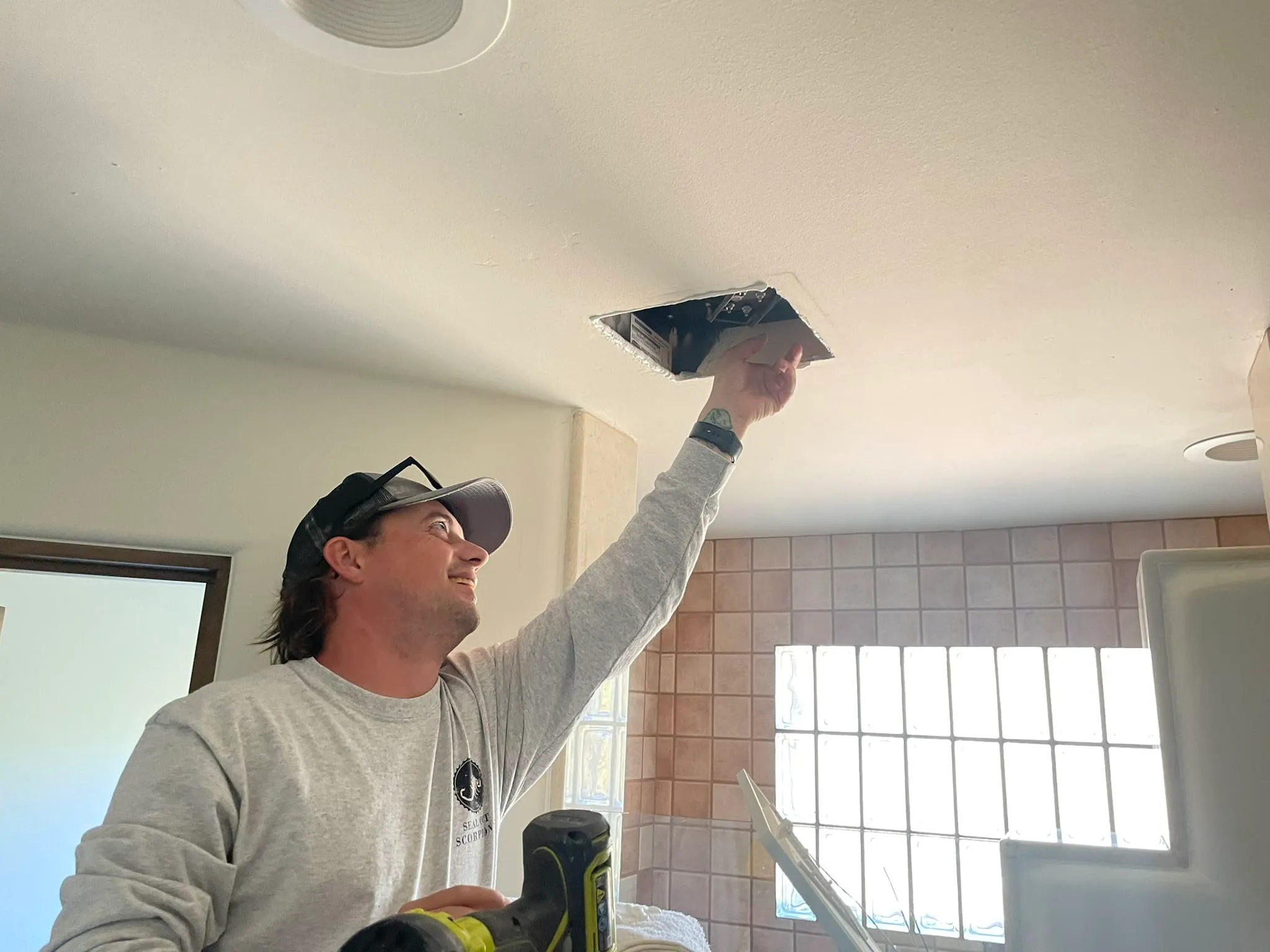
“I’ve built over 600 upscale custom homes in my 32 year career. I was skeptical about the work that was going to be done by Seal out Scorpions but read the reviews and decided to take a chance. The crew they sent out sealed ‘Everything’ plugs, switches, vents, light fixtures, baseboards and doors! They did some of the best quality work I’ve seen inside and out and double checked everything with a special light when they were done.”
Randy King, five-star Google review
Your Yard Isn’t The Problem, But It’s Part Of The Picture
Gravel beds, drip irrigation lines, decorative boulders, and shaded planters all create microclimates that support crickets, roaches, and other insects, and those prey populations indirectly sustain the scorpions around your property.
We don’t advocate tearing out your plants and irrigation. Instead, we help you identify how your outdoor environment interacts with your home’s vulnerabilities, with prescriptive strategies rather than generic recommendations, so you keep the yard you love while cutting the factors that draw pests closer.
Why Spraying Falls Short In Arizona Heat
Most homeowners know the traditional routine: a technician sprays the perimeter, treats the block walls, applies residual products. The problem is that Arizona’s intense heat breaks many of those pesticides down quickly. By the time you believe you’re protected, much of the active ingredient may already be degraded, especially on surfaces in direct sunlight. On some days that can happen within minutes of application if it isn’t compensated for.
Exterior block fences are the worst case. They soak up extreme heat and absorb the product, which is one reason general perimeter spraying does so little to stop scorpions. If you’ve had regular service and still see activity, that’s the mechanism, and it’s why scorpions keep coming back.
Does spraying do anything at all, then? Used prescriptively, in the right places at the right times, treatment has a role inside a larger system. As the stand-alone plan, it’s short-lived chemistry against a long-term structural problem. Our five strategies for scorpion control shows where treatment fits.
Why Basic “Pest Control Sealing” Misses The Point
Many pest control companies offer what they call sealing as an add-on: caulking, door sweeps, patching a few visible gaps. Helpful on the surface, but it overlooks the hundreds of smaller, hidden micro-air leaks actually responsible for drawing pests inside.
Partial seals can even backfire. Sometimes they help temporarily. But sealing a handful of obvious leaks while ignoring the network of tiny structural penetrations can increase the pressure differential across the leaks that remain, and over a year or two that reroutes air, and pest pathways, into less desirable areas of the home.
There’s also workmanship. Generic sealants degrade fast under Arizona sun and temperature swings, leaving what we think of as sealant scar tissue: failed caulk lines and gummed-up applications that do little to stop airflow long term.
The real solution is understanding your home as a complete system. How air moves through it, how pressure differences pull exterior conditions inside, and how scorpions naturally exploit those pathways. That’s why our approach centers on Building Performance Sealing, grounded in building science and tailored to your home’s structure and airflow, closing the true routes pests use to get indoors. Our team members are Certified Building Analysts and Envelope Professionals through the Building Performance Institute, and the discipline goes beyond scorpions: it diagnoses and corrects the structural, pressure, and thermal imbalances that draw and allow pests indoors.
Preventable And Curable, When You Treat The Cause
At Seal Out Scorpions we see scorpion problems as preventable and curable. That’s only true when you look past chemicals, basic pest control, and handyman sealing that covers what’s obvious, and treat the issue at its origin: the building envelope and how it interacts with the surrounding environment.
Think of it like seeing an orthopedic specialist instead of a general practitioner. We start by evaluating how your home breathes, where it leaks, and what pressure or humidity conditions are quietly inviting scorpions in. Then we provide a clear plan, which might include Building Performance Sealing of hundreds of micro-air leaks and hidden structural gaps, an assessment of attic and wall-void conditions, and coaching on keeping the home protected. And we prioritize aesthetics: we seal in ways you typically can’t see at all, or that leave the home looking more finished than before. The work should solve the problem at its root and preserve the look of your home while it does.
“Prior to contacting seal out scorpion we had hired a different company to come spray our home every month. Every month they would come and spray but over time, we would see the scorpions drop off and than continue to come back. I have been bit 3 times in my home and on the 3rd time I was done.”
Tamisha W., five-star Yelp review
Our Philosophy: Educate, Coach, Empower
Our mission isn’t to scare you into another routine spray contract. We don’t run subscription contracts like general pest control services. We offer prescriptive and specialty services, and we educate and coach you on why scorpions keep showing up and how to take control for the long term. When you address the building itself and how it relates to its environment, you solve the real problem, and scorpions stop being a recurring issue. Fixing the cause beats chasing symptoms, every time.
How Each Season Shapes The Strategy
We look at scorpion control through the lens of the entire year, because each season has a role:
- Summer is about suppressing symptoms. Pests are most active, so targeted treatment reduces the immediate pressure around the home.
- Fall is about preventing move-in. As temperatures drop, pests seek sheltered voids to overwinter, and the goal is keeping them out of attics, walls, and crawl spaces.
- Winter is about building the property’s immune system. This is when we shore up vulnerabilities and reinforce the barrier, as we explain in bark scorpion control in the winter.
- Spring is about changing the path. As everything wakes up, we influence how and where pests concentrate around the property so you’re not set up for another surge.
When’s the best time to seal my home? Before the problem gets established, or as soon as you realize there’s an issue. Sealing early is like treating an illness at an early stage: correct the underlying vulnerabilities sooner and it’s far easier to keep them from progressing into something stubborn. Waiting rarely makes it cheaper or simpler.
Want To Understand Your Home’s Vulnerabilities?
We offer phone assessments, and onsite assessments for complex properties, that uncover exactly how your home’s structure may be inviting pests inside. From there you’ll have a roadmap to decide how far you want to go. Check the pressure in your own neighborhood on our scorpion heat map, then call or text 480-820-7325 (480-820-SEAL if that’s easier to remember), request a quote, or read what other Arizona homeowners experienced first.
No hype and no pressure. Straightforward expertise, tailored to your home and your goals, so you can make the best decision for your family.
Georgia Clubb is the owner of Seal Out Scorpions in Tempe, Arizona. ROC 287016, OPM 9658. Licensed, bonded, and insured.